Sunday, December 19, 2010

The challenges of being a straight 'feminist'

The title of this new set of rant and rambling is not to suggest that most or a lot of feminists are gay or as they are offensively called 'Dyke'. But I will, nonetheless, purport that being the two together can really challenge handicap your personal life & the chances of romance in it.

I believe the contemporary world is actually much more archaic than we are led to believe or would like to believe. And when I say archaic, I quite obviously refer to the pillars of patriarchy holding a firm control over everything that gets decided or in the way things are concluded. Hence, essentially we are the socialized products ergo victims of the 'archaic patriarchal' processes.

Let me clear here that feminism does not interpret itself to hating 'man'kind. In fact, feminism is a lot similar to anarchy which is all about sticking it up to 'the man'. Feminism is, simply put, about egalitarianism. However, because of the way we've been socialized ergo victimized, the idea of a man and a woman on an equal pedestal or their roles being flexible from what it used to be or as naturalists argue, "what it was designed to be in the first place', is just so insufferable to 'the system' i.e. of course the invention of man alone.

Get the picture? That most guys I talk this kind of shit to would just take on their heels and dash. Men only seem to want women who titillate them, live out their (highly socialized and misconstrued) fantasies and claim no more than what they are 'originally' entitled to. I don't know of too many men who'd like a counterpart that challenges them or forces them to think beyond the given. Maybe its coz men are privileged enough (as socialized) to be born in the gender and that the world is at their feet leaving them nothing more to strive for.

As strong headed I come off in these writings, I am actually a very chilled out person. I don't have too many demands especially not the petty ones like, "Why didn't you call me to say goodnight?". But I've realized men don't mind these kind of petty demands. They'll get you the chocolates, the teddy bears and you can enslave them to a world of material requests. But where it really counts (for women like myself) to assert or ask to be treated with respect, perhaps equality, they tend to take it personally i.e. on their masculinity a.k.a manhood. This only leaves you to be a....


"Sensitivity. Empathy. Acceptance. Hey, that's what your gay friends are for!"
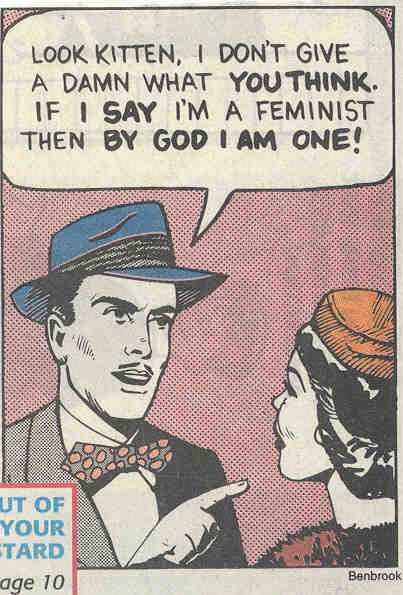
I used to have similar kind of conversations with a guy I dated 
No, this is not a male bashing exercise. If you have any sense at all, you'd be able to tell that I'm trying to highlight the dysfunctions of a system too stagnantly long in place. Men are not emotionless creatures. A lot of male bashing happens on this perceived pretext, which is another product of the patriarchal menace. But what is true about men is the sense of great denial they live in for the longest time. Its like a bubble they don't want to burst or a safety blanket they don't want to slip out of. So if you throw words like subjugation, misogynist or chauvinist at them, they would confidently and earnestly deny the charges. No guy wants to be 'the bad guy' but I think they sincerely don't know how or when they are being just that.

"If you have so many complaints with men and since there are no good ones out there, why don't you give women a shot?" This is a question often thrown my way and honestly I think its pretty offensive. It purports women as second choices to men and perpetuates the stereotypical belief that women turn to women only out of their frustration and scars with/from men.
Also, do I really have to make such extreme choices in life? That I either have to settle for being the gilded bird or switch my orientation to feel loved, desired and appreciated?

Patriarchy is leaving this little faith in 'man'kind and giving so little credit to womenkind. Who the hell is profiting from this then?

Saturday, December 11, 2010

All you need is love

As the year is coming to a close, my habitual reflection on the events that occurred has already begun. It is all but normal to do that and I don't think I'm the only person who sits and wonders to judge whether or not this year has been good for her in terms of accomplishments, stability, excitement, adventures, love and general happiness.

I seem to have drawn a pattern from my year end evaluations where I believe that all my transition years have been difficult, even if rewarding and highly fulfilling. Well, I can't deny that as I grow older, life just gets tougher and the sooner I accept that the better it is for me. And really, the kind of person I am and given the age phase that I'm in, changes or transitions are not inevitable but also GOOD! Yet, one cannot disagree to say that transitioning phases have a unique sense of struggle to it, no matter what.

All in all, it has been going quite great! I'm finally out of the dreadful education system that I felt I was rotting in and feel that I'm living out the greater part of my potential out in the professional field. And though, I have tons of complaints while even being part of the action, I wouldn't wish to ever go back. Well, I wouldn't wish to go back on anything. Is that a sign of contentment?

I thought researching, documenting and analysing my quarter life crisis would help me to prepare myself for future surprises, bolts and hiccups well, which it has, but it hasn't resolved all the issues from the past, which is an unrealistic expectation to begin with. Events and instances helped me realize that I'm still carrying so much baggage from the past to the point that I've felt no better than I did when I was 16. The repercussions of this realization made me feel small, immature and inferior to many in my league and peer group. But since I'm in no pressing hurry to grow up, it also gave me a lot of breathing space to just be myself. Seeing a few friends marry and some others contemplate their long term commitments as potential nuptial ties, it just made me think how I am nowhere close to even being ready. There are those who think in a few years of 3-4 while others can't imagine any possibility due to the lack of a present prospect, I neither can put a time line to it nor can I guarantee I'll be able to if I find a stable companion. In fact, just the possibility of meeting a great guy (one who doesn't have unresolved baggage or act like a college kid) seems quite fantastical at this point.

I don't think I'm even a quarter of the woman that I can be or want to become. I think I've just begun to have a taste of life. I think I'm really still negotiating a lot of personal spaces in terms of relationship with my parents, the kind of girl I am, the kind of girlfriend I make etc. I'm just slowly sinking into responsibilities but the best part of it is that I'm choosing and creating those responsibilities instead of just accepting whatever's thrust my way (Of course, I do get a lot of flak for not easily succumbing to the latter).

What I've liked most from this year is how I've begun charting out my path in life and that for me is the most important. Surely doing something like this is not easy and is bound to be difficult when more so often you find yourself alone on your side versus everyone. Its been so difficult that at times I just have wished to be like everyone. Actually, I've wished that I was someone who'd do what everyone did in blissful ignorance. That way, I wouldn't have had to deal with most of my painful deviances. Its not that I'm trying to be different, its just that I am, involuntarily. Blind acceptance I have tried, very earnestly, and have failed apart from being miserable. Either way, I'm miserable. Might as well be while doing my own thing.

Here's to another year of being miserable my way!

P.S. Maybe what I can hope for the new year is to be loved more generously. I think I have been praised or appreciated in my moments but the love has been missing for a while. And its not JUST pampering and coddling that I refer to, although there's nothing that a soft, big kitty likes more than being hair brushed and warmly rubbed. No, I'm not suicidal. I do know that people love me but that's more like a cognitive awareness than an emotion I was made to feel. We all need to be made to feel special and loved in all display, gesture and touch. Is it too much to ask for without belittling me in judgement?

Saturday, October 30, 2010

You may win some but you always lose more


There’s always a price to pay for every privilege. Business travellers pay more and fly the same distance in luxury. Women have seats reserved in metros and buses, but are classified in the same category as children, the elderly and the disabled. Minorities do have seats reserved but practically no power to wield.

Caste in India is a socio-political issue, just like race in America or class in Britain. Yet ever since the decision on its inclusion in the ongoing census has been passed, the focus hasn’t shifted from political agendas, reservations and resource allocations to the discussion of its implications on our social structure. And in talking about caste in a social structure, it fits categorically under those who have ‘made it’ to the mainstream and those who ‘remain’ marginalized to the fringes of development.

Standards of living have notably improved across sections of the society, sometimes even inequitably so. There is a significant group who may be registered as ‘constitutionally backward’ yet have more money to burn than the common man on Diwali. But this very segment of the society stands testimony to the fact that financial strength can only take one so far, not close enough to the milestones of adequate exposure and access to better standards of development.


A caste census practice could, therefore, move the needle on the development of these very segments who have thrown in the towel to relax under government schemes. But they cannot be easily dismissed as being unmotivated or lazy. Take the instance of Native Indians in America living under umpteen number of government welfare schemes like health care, education, employment, housing etc. Despite support, many live below the poverty line, are less educated, and geographically more isolated. There are many reasons for this but what’s apparent is that, as a race, they have been accorded no contemporary importance (or relevance) in modern day American society.  Thanksgiving, as a tradition, is a persistent practical joke on how they were displaced from their land and authority. For those whose voices have been silenced for so long, it takes a while for them to become audible. 

Thus, it’s not always just lack of ambition that limits them but how mainstream society perceives them. Cultural differences aside, different communities and castes grow up differently in lopsided socio-economic situations also because of an implicit hierarchical structure. Pre-independence, this structure being more explicit, it determined a person’s way of life. Now, even though caste is only one of the defining factors since individual merit counts, studies like those of Prof. Narasimhachary, a Senior Associate Fellow at the Oxford Centre for Vaishnava and Hindu, reaffirm that caste consciousness continues. Prof Narasimhachary’s study declares, “The implication to be of a high or low caste is a matter of innate quality or essence”. How far then is an individual removed from society?

I think the mainstream and the marginalized fall into patterns all over the world: the mainstream, who dominate society’s mannerisms and for whom it is convenient to overlook injustices and dirty loopholes; and the marginalized, who are hyper vigilant about gestures and nuances of behaviour towards them only because they are never made to feel ‘normal’. From a grim perspective, it’s kind of like being branded with the yellow ‘Star of David’.


From a personal stand, I’ve used the reservation system to my own advantage, without coming from a downtrodden situation for which it’s supposedly meant. It has been responsible for some lack of competitive grit in me as I have been entitled to the same, perhaps even more, than those who had more merit on their profile. But make no bones about it when I say I’ve been judged, exposed and humiliated on the sole basis of my background. Reservations were never meant to be leftovers to toss to the helpless but as a means for diversity to infuse the mainstream.


In a recent job interview with a noted social activist, I was briefed about a less than desirable grammar in my compositions despite being a published and well appraised writer. I had been called only to be ‘given a chance’ so that I could make her office “colourful” as I represented, and I quote, “those who came from the far flung regions of our big country”. I wondered if this is a price I will perpetually pay for coming from where I do. Where is the fairness in this and what would be fair, after all?

These are questions that have no easy answers or direct solutions. And these questions are always hotly debated with vested political interests. Inclusion of caste in the ongoing census is neither a solution to the problem nor the problem itself. Neither is caste the problem and the differences caused by it. It is the attitude towards this diversity that makes all the difference in the socio-economic food chain.

“Imagine all the people…sharing all the world”

Will this only remain Lennon’s dream?

For a good comprehensive overview of the caste system, the author recommends the summary of Professor M. Narasimhachary’s lecture in the IK Foundation Lecture series, ‘Indian Culture in the Modern World’

Originally published on 30th September, 2010 in The Alternative.  


Ring a bell, end the fight!


A UN report points out that one incident of violence in India translates to the victim losing seven working days. The report further says that violence against women puts a huge strain on the nation's social and legal services. Unfortunately, domestic violence is a part of every day, even accepted, reality in various households. For reasons of shame and family honour, many cases of domestic violence go unreported.


Breakthrough (India) has been working on the issue of violence against women since its inception in 2000. With the Protection of Women from Domestic Violence Act (PWDVA) coming into force in 2005, they began discussing its implementation using mass media and mobilization as strategic tools. “We really wanted to create a campaign where we ask….here is a legal response, what about the social response?” notes Sonali Khan, the Country Director of Breakthrough.


Prior to the present decade of media campaigns, Mallika Dutt, Founder & CEO, recalls, “I have always felt that the language used in the human rights world does not reach the kind of wide-ranging audiences necessary to produce real change. A global conversation about human rights involves everyone--not just the usual suspects in the NGO circuit. I began questioning how to use more mainstream strategies to engage different people in conversation with accessible tools that really speak to their values.”


Their first successful experiment was "Mann ke Manjeere" - a music album on domestic violence starring Shubha Mudgal - which generated a lot of media coverage and reached huge audiences. Then came Bell Bajao – a social media campaign that urged people to “ring the bell” and bring domestic violence to a halt.


The highly popular campaign that aired on Doordarshan, private TV and radio channels, reached more than 130 million people and won prominent awards like the Gold for Best Integrated Campaign 2008 at the Goafest Abby Awards; the most recent one being the prestigious Silver Lion in the Film Category at the Cannes Lions 57th International Advertising Festival.


Did the unique media messaging strategy work? Urvashi Gandhi, Manager of the Community Leadership Program says, “Each case of domestic violence is very specific. You cannot apply one situation, copy paste it and put it on to the other. When people look for solutions and options to come out of it, they are looking for specific information. Media campaigns are just for sensitizing and creating awareness.


To further the reach of the campaign, video vans travelled to different towns and districts in Karnataka, Uttar Pradesh and Maharashtra. The video vans engaged the audience through games, interactive discussions and quizzes besides airing the ad campaigns done pro-bono by Ogilvy & Mather. Recently, popular Bangalore based folk rock band Swarathama performed with the video van in Puttur, Karnataka.


It’s not just about the fun and games, clarifies Gandhi. The van is on a serious mission. “Lot of times there are queries and incidences of violence that people in the community would come and share with us. They ask us for information on what to do next”, she says.


The real success of the Bell Bajao campaign is easily rooted to the rights advocates who spread the message in their communities and mobilize individuals. “In one of the villages in UP, where we had taken the van, they just said point blank that domestic violence does not happen in this village. So please take the van out of here, you’re spoiling our women. In cases like these, we have trained people from the area who try and get the word around by having unofficial, informal talks rather than going to them as a video van.”


The whirlwind of difference the training programs have made to these individuals’ attitudes and lives is touching in their testimonies.


Suresh has been a Breakthrough Advocate since 2007 and a more prolific human rights activist, participating in street plays and travelling with the video vans across Karnataka. While he’s done much to sensitize the world outside, change for him always has begun at home. Over the last few years he has started helping out his mother and sister-in-law with household work. On his brother’s wedding day, he sang a song that translates to something like, “…the bride you’re marrying is just another person like you. You have to treat her as an equal. She also has a heart, she has aspirations. Don’t think you are marrying just a body. Beating up your wife is no indication of your masculinity. Don’t think of yourself as God and her as your slave…


Hina, a student in Lucknow who underwent the training said that earlier she used to be a very shy person, who could never talk about condoms, sexuality etc. But now she feels comfortable and confident. One of her relatives was a victim of domestic violence and she was unable to take any action against this because neither she had confidence nor any legal knowledge. Hina educated her relative and extended support along with other trained volunteers.


The campaign that has Boman Irani as its ambassador, looks at men as a part of the solution rather than as the problem. “Men can act as role models. It’s essential to engage them to act against violence for women in a more proactive and positive way which is not founded on guilt but more in terms of respect for women”, enumerates Khan.


At the end of the day however, the campaign is benefitting more women than men. “Very interestingly more number of women are actually ringing the bell. Because if you think about it, it’s a safer way for women to intervene”, she adds.


As a part of their 360 degree focus, in addition to digital mapping of resources, testimonials & video van routes of the PWDVA and a music video of Swarathama performing live with the video vans, they are pushing now to get more and more groups of people, influencers as well as gatekeepers, from the fashion industry to panchayats and the underprivileged to become a part of the campaign. “The word Bell Bajao has become very synonymous to taking action against what’s wrong” concludes Khan in a celebratory tone.


If this rings a bell for you, do ring a bell for someone else.
You can catch all the Bell Bajao ad campaigns on www.breakthrough.tv


Contacts:
contact@breakthrough.tv
Web: www.bellbjao.org


Originally posted on 11th August, 2010 in The Alternative

Friday, October 29, 2010

His honour to kill and her fate to die?


We call our nation Bharat Mata, Dharti Maa. We worship many Goddesses. However, we revere them on conditions of ‘purity’ and ‘chastity’. 

This feminine idolization or idealization doesn’t quite settle. Economically we’re booming but culturally still misfits; not as per the norms of the ‘Great White Man’ but even by our own ‘Asiatic’ standards of adaptation in a global village and by universal standards of human rights.

The recent rise in reports of young men and women being murdered in the name of honour has been crucial in throwing light on a long continuing trend that the local law, for reasons of both corruption and tradition, have kept under wraps; and the urban educated had until recently become oblivious to.The exposure of honour crimes has been a serious reality check - barely 5 kilometers from the fringes of our flourishing cities thrives an alien culture.


Honour - A word that spells collectivism not only in definition but to a greater degree also patriarchal in an Indian context. Instances of women dying in the name of honour have been witnessed through history in a multitude of forms. The earliest that one recalls is the now abolished Sati, legitimately practiced pre-independence, when women threw themselves or were thrown in the funeral pyre of their husbands.
One shudders to recall the chaos of the India-Pakistan partition during which women’s bodies became the site of offense and defamation. Most female victims in the massacre died by their own hands. Urvashi Butalia, in her book ‘The Other Side of Silence’ which recounts survivor experiences of partition from a feminist perspective, talks about the status of women who willingly killed themselves to save their own or their family’s honour, and women who were abducted by mobs from either side of the border. Survivors, mostly male, emphasized the ‘heroic’ and ‘valorous’ aspects of these tragic deaths as she observes, “…while abducted women entered the realm of silence, women who were killed by families, or who took their own lives, entered the realm of martyrdom”.


A remarkable movie that dealt with the subject matter of women's sexuality subject to honour and violation during the India-Pakistan partition

What gets purported in the repeated incidence of such acts and society’s legitimate acceptance towards them is the psyche of the woman being the bearer of family honour, dictated by masculine prudence. It is not to say only women come under the knife or bullet for supposedly dishonoring their families. News reports show both lovers being slaughtered for committing the forbidden. On April 4, 2009 Reuters had reported the honor killing of four gay men in the Sadr city slum of Baghdad. Men, too, are paying an equal, if not heavier, price for patriarchy.

Courtesy front pages and breaking news, honour killing has become the intellectual subject of a human rights debate. At this moment, however, more judgments are being passed where answers aren’t available, which is, again, a sad consequence of reportage. Speed trials and judgments deliver justice in time but do not prevent recurrence of the crime. More questions need to be raised, sensitively and sensibly. Only by addressing the issue from within will we be able to gauge more reasonably this culture of violence against women, something that the criminal justice system does insufficiently.


In the contemporary scenario of honour killings, two fresh angles are being recorded. One - women are neither silent nor passive spectators in such incidences. The abhorrent case of Delhi based journalist Nirupama Pathak’s own mother doing the dirty job questions the theory of maternal instincts against all odds. In an interview to Association for Women’s Rights in Development (AWID), Rana Husseini, author of "Murder in the Name of Honor", on the role of women in honour killings said that they are usually divided into a) those who don’t have a say in the issue; if they stand up and speak, they might get killed themselves. That’s how they wind up as accomplices, b) others who really believe that the woman should be punished and that it will be a lesson to others in the family.
                                                    The second focuses on the system of castes and communities like the Khap Panchayat who glorify such crimes as their moral duty in preserving the sanctity of their community. There are debatable theories of ‘sick societies’ and in situations like these, it’s a real struggle to draw a line between mental health and cultural sanction. Is it more disturbing to think that it was a collective stand or that it didn’t prick their conscience? Further, the question here is if conscience is embedded in morality, which is certainly more culturally defined, or independent from it.


Writing for The Times of India, Madhu Kishwar sought to protect the rights of any community like the Khap Panchayat to, “insist on the right to decide for itself what aspects of tradition they wish to cherish and what they wish to discard or reform, provided its leaders can enforce community norms through democratic consensus”. 

Rightfully, such a negotiation must be worked out wherein a sensitive approach is taken, one which does not lambaste community norms and cultural sentiments nor puts caste adjudicators on such a high horse where they decide who lives or dies in shame or honor.

The highlight on the murder of the Delhi based journalist, Nirupama Pathak, who came from a family with an impressive educational profile, also forces us to identify the line that many Indians demarcate between ‘education for occupation’ and ‘tradition for living’. Are we essentially the same people from the period when Granths and Vedas were written, only with touch screen devices now to read them from? Isn’t ‘honour killing’ a practice no less cruel than Sati was?

Northern states like Delhi, Punjab and Haryana have the fastest growing economic and social enterprises; yet the sex ratio remains abhorrently skewed. On the far end, although the eastern and north eastern states of the country continue to struggle with sufficient economic provisions, let alone investments; dowry death, rapes or honour killings were somehow never a part of their contemporary history. These places are yet to progress to a level that can provide more than the traditional opportunities for women, but they are not currently debarred from the existing options in occupation or education. Rather than looking west, some of these sex skewed states could more realistically emulate their own neighbours…their own brethren.

It is imperative here to understand two ideas in the context of integration. One, for the development of any state wherein infrastructural growth must accompany (or at least be followed by) cultural revolution or else the gap widens and development becomes like a hollow, empty barrel with a superficial crust. And the other is of national integration via communication and cultural exchange.

Despite the multitude of reasons and contexts in which honor killings take place, it should be repeatedly reminded that the supreme courts are above all local laws and cultural collectives and that the only exception to murder is self defense, not ‘honour’. 


Originally posted on 5th July, 2010 in The Alternative